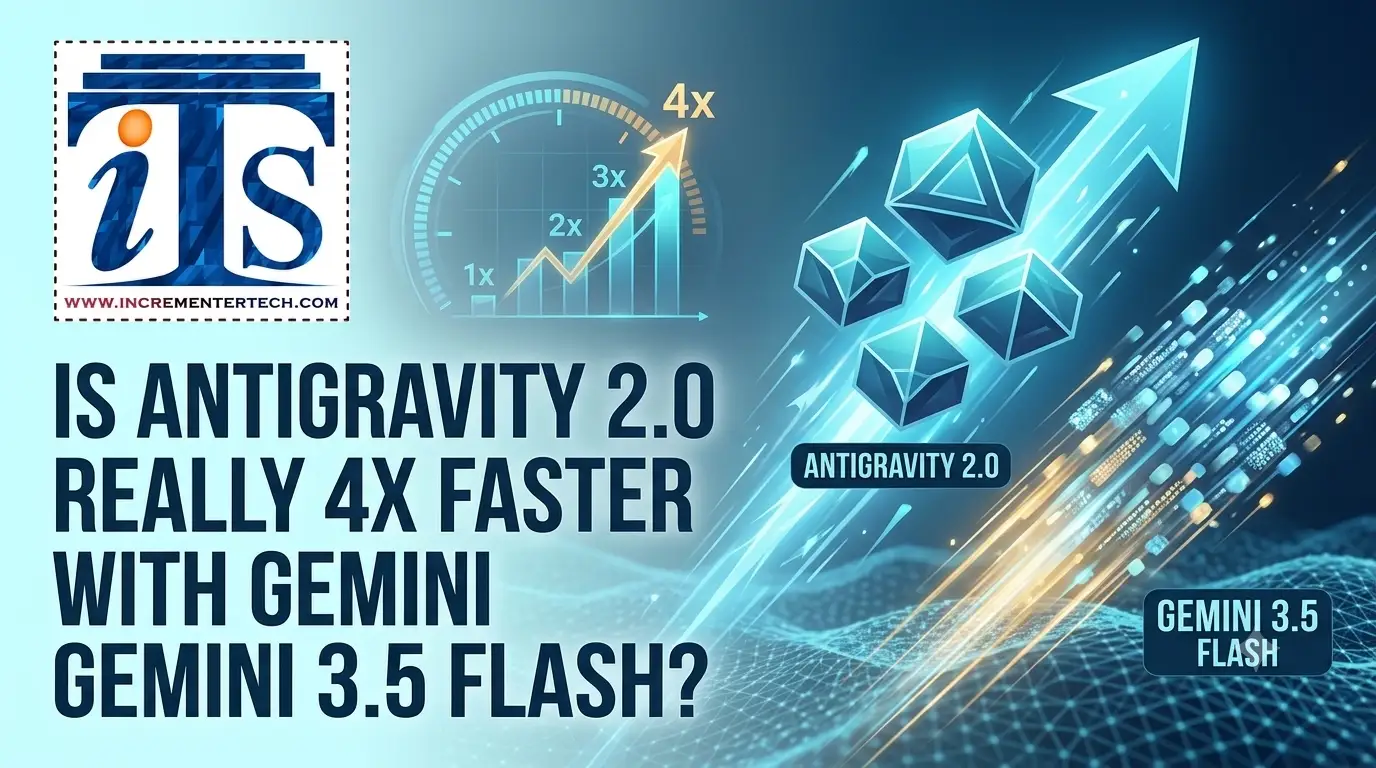
Is Antigravity 2.0 Really 4x Faster With Gemini 3.5 Flash?
Google Antigravity 2.0 and Gemini 3.5 Flash are attracting developer attention. Will Google Antigravity 2.0 agents be 4x faster with Gemini 3.5 Flash? This guide explores agent speed, coding workflows, and practical use.
Can Antigravity 2.0 Make Coding Agents 4x Faster?
Google Antigravity 2.0 is positioned around AI-assisted agentic development, while Gemini 3.5 Flash focuses on fast model responses and coding workflows. For teams evaluating AI development platforms, understanding how these technologies work together is more useful than relying only on a headline speed claim.
For a best web development company in India, faster coding agents could potentially improve prototyping, debugging, code generation, testing, and repetitive development tasks. However, actual productivity depends on model performance, task complexity, tool calls, context handling, infrastructure, and human review.
- What Is Google Antigravity 2.0?
- Why Does Agent Speed Matter?
- Faster agents can reduce waiting time during development. Potential benefits include:
- Will Google Antigravity 2.0 Agents Be 4x Faster?
- How to Use Google Antigravity 2.0?
- Developers exploring how to use Google Antigravity 2.0 should begin with small, measurable workflows rather than immediately delegating an entire application.
- Can You Use Gemini 3.5 Flash for Coding Agents?
- Why Does This Matters for Web Development?
- A best web development company in India can potentially apply agentic AI to:
- Frequently Asked Questions (FAQs)
- Will Antigravity 2.0 agents be 4x faster?
- A 4x improvement may occur in particular workflows, but it should not be treated as a guaranteed speed increase for every coding task.
- Is Gemini 3.5 Flash useful for coding agents?
- It can be useful for fast coding assistance, iterative development, debugging, and other agent-driven software engineering workflows.
- How do I use Google Antigravity 2.0?
- Start with a clearly defined development task, provide appropriate project context, review agent-generated changes, and validate the output through testing.
- Can AI agents replace web developers?
- AI agents can automate repetitive development activities, but developers remain important for architecture, security, requirements, testing, judgment, and quality assurance.
- Should businesses adopt AI coding agents?
- Businesses should evaluate them through controlled projects and measurable productivity, quality, security, and cost benchmarks before broader adoption.
- Conclusion
Google Antigravity 2.0 functions as an agent-focused development environment, using AI agents to support developers with various software engineering tasks.. Instead of generating isolated code snippets, an agentic workflow can involve planning, coding, testing, debugging, and iterating.
● Quicker code generation and iteration
● Faster debugging cycles
● More responsive development workflows
● Improved AI-assisted testing
● Better support for repetitive engineering tasks
A 4x faster result should not automatically be interpreted as every coding task becoming four times faster. Agent performance can vary according to workload, model latency, tool usage, context size, and the number of actions required.
| Factor | Possible Impact on Agent Speed |
|---|---|
| Gemini 3.5 Flash | Faster model responses may reduce latency |
| Agent planning | Complex tasks can require additional steps |
| Tool calls | External actions can add processing time |
| Codebase size | Larger context may affect responsiveness |
| Testing | More validation can increase task duration |
| Human review | Final productivity still depends on developers |
Therefore, Will Google Antigravity 2.0 agents be 4x faster with Gemini 3.5 Flash? The practical answer is: potentially for selected workflows, but a universal 4x improvement requires independent benchmarking across comparable development tasks.
1. Define a specific coding objective.
2. Give the agent clear project context.
3. Ask it to plan before modifying code.
4. Review generated changes.
5. Run automated tests and validation.
6. Measure completion time against a conventional workflow.
This approach also helps teams determine whether Gemini 3.5 Flash provides meaningful productivity improvements for their particular projects.
Yes, developers can evaluate the use of Gemini 3.5 Flash for coding agents scenarios where fast responses, code generation, debugging assistance, and iterative development are important. The strongest outcomes usually come from pairing AI agents with clear prompts, codebase context, automated testing, security validation, and ongoing developer supervision.
● Front-end component development
● API integration
● Unit-test generation
● Bug investigation
● Documentation
● Refactoring
● Development automation
Google Antigravity 2.0 paired with Gemini 3.5 Flash could make agent-assisted development more responsive, but “4x faster” should be validated rather than assumed. Businesses should benchmark real workflows involving coding, testing, debugging, and deployment. For a best web development company in India, combining AI agents with experienced developers, secure engineering practices, automated testing, and human oversight can create a practical path toward faster, scalable software delivery.